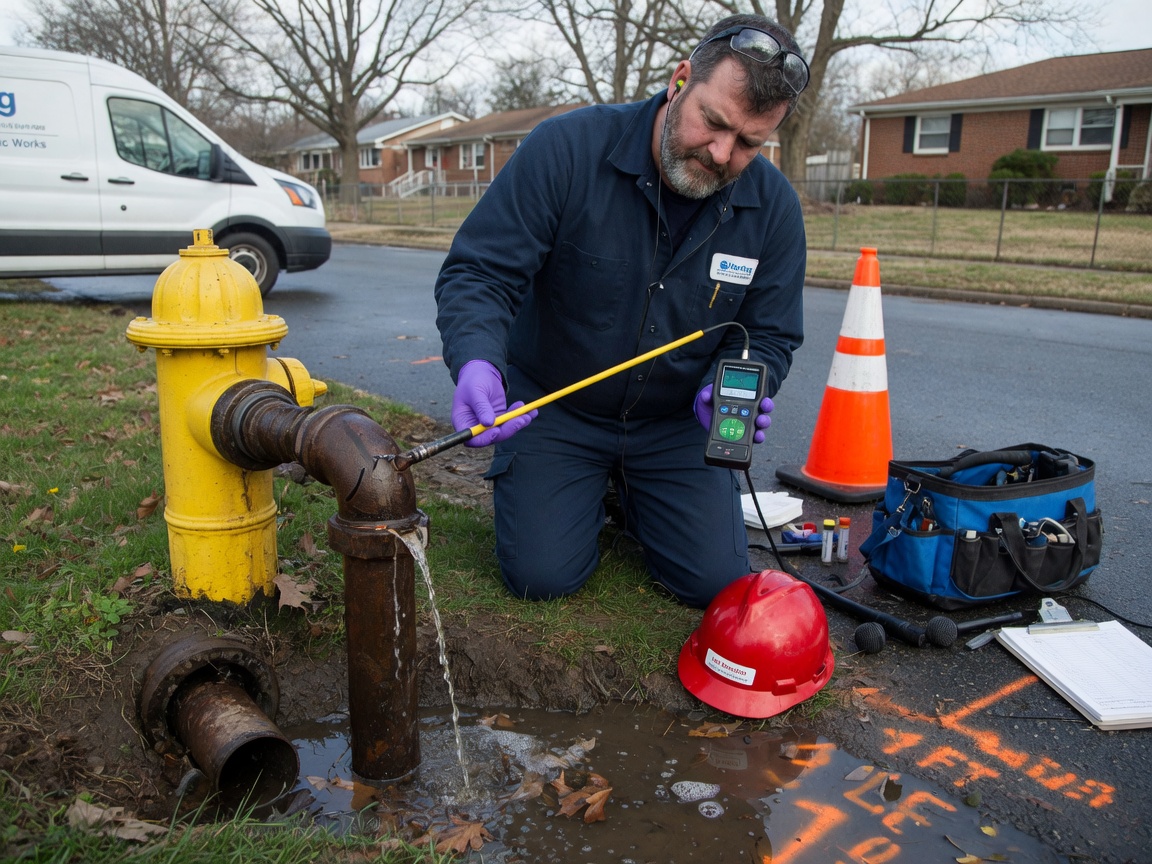
Sterling homes built before the mid-1990s often contain galvanized or copper supply lines that corrode where they pass under slabs. Four distinct seasons create repeated expansion and contraction cycles; chilly winter nights followed by warm days stress joints near Claude Moore Park and Dulles Town Center. When moisture migrates through Loudoun County’s clay-heavy soils, it travels laterally before surfacing, so detection must account for both the pipe material and the soil type rather than assuming straight-line travel.
Technicians working in Cascades and Ashbrook routinely encounter PEX retrofits that were tied into older copper stubs without proper dielectric unions. These mixed-material transitions create pinpoint leaks that standard pressure tests miss because the leak rate changes with daily temperature swings. Electronic amplifiers placed on the slab surface pick up the distinct frequency shift caused by water escaping under pressure, while video inspection confirms the exact joint once the general area is isolated.
Nearby Ashburn and Herndon developments share the same Loudoun County water chemistry that accelerates dezincification in galvanized lines. Homeowners in Sterling Park frequently report faint musty odors near baseboards before any visible water appears, because the slab acts as a thermal mass that hides moisture until saturation occurs. Proper detection therefore combines acoustic listening, moisture mapping, and selective pressure isolation rather than relying on a single tool.
Technician insight
In Sterling, the thing that catches most people out with Pipe Leak Detection is the transition from galvanized to PEX in 1980s Sterling Park homes; the dissimilar metals create micro-leaks that only show on acoustic gear during the first cold snap of winter when the slab contracts.
Hidden Leak Under Family Room Slab
A Cascades homeowner noticed a slight drop in water pressure and musty smell near the baseboard. Acoustic scanning isolated the sound to a copper stub tied into later PEX under the slab. We isolated the leg, confirmed with video, and marked the spot for targeted repair without removing the entire floor.
Pipe Leak Detection Services We Offer
✓Acoustic Leak Detection
Uses ground microphones to isolate leak sounds through concrete slabs common in Cascades and Potomac Falls homes.
✓Video Pipe Inspection
Camera insertion through cleanouts locates joint failures in older copper lines throughout Sterling Park without slab removal.
✓Pressure Testing and Isolation
Section-by-section pressure checks identify which supply leg is losing water in mixed-material systems found in Ashbrook.
✓Thermal Imaging Scan
Infrared imaging reveals temperature differentials from active leaks under slabs during Loudoun County’s winter temperature swings.
✓Moisture Mapping
Pin and non-invasive meters chart moisture migration patterns through clay soils typical around Claude Moore Park.
Pipe Leak Detection Cost in Sterling, VA
| Service | Typical Range | What Affects It |
|---|---|---|
| Basic Acoustic Scan | $275–$450 | Single-story slab homes with good access points |
| Multi-Zone Pressure Test | $350–$550 | Homes with multiple additions or mixed pipe materials |
| Video Inspection Add-On | $175–$300 | When cleanout access exists and visual confirmation is needed |
| Thermal Imaging Scan | $225–$400 | Winter calls when temperature differentials are clearest |
Ranges are typical for Sterling, VA and confirmed with an exact written quote before any work starts.
How it works
- 1
Initial Consultation
Review water bill history and visible signs at the Sterling address to narrow likely pipe routes.
- 2
On-Site Assessment
Map accessible valves and determine which detection method suits the home’s construction era and slab condition.
- 3
Leak Isolation
Apply acoustic or pressure methods to pinpoint the leak while protecting finished surfaces.
- 4
Verification And Report
Confirm location with secondary tools and provide a written diagram for repair planning.
Pricing
Pipe leak detection in Sterling typically falls between $275 and $750 depending on access difficulty and number of lines tested.