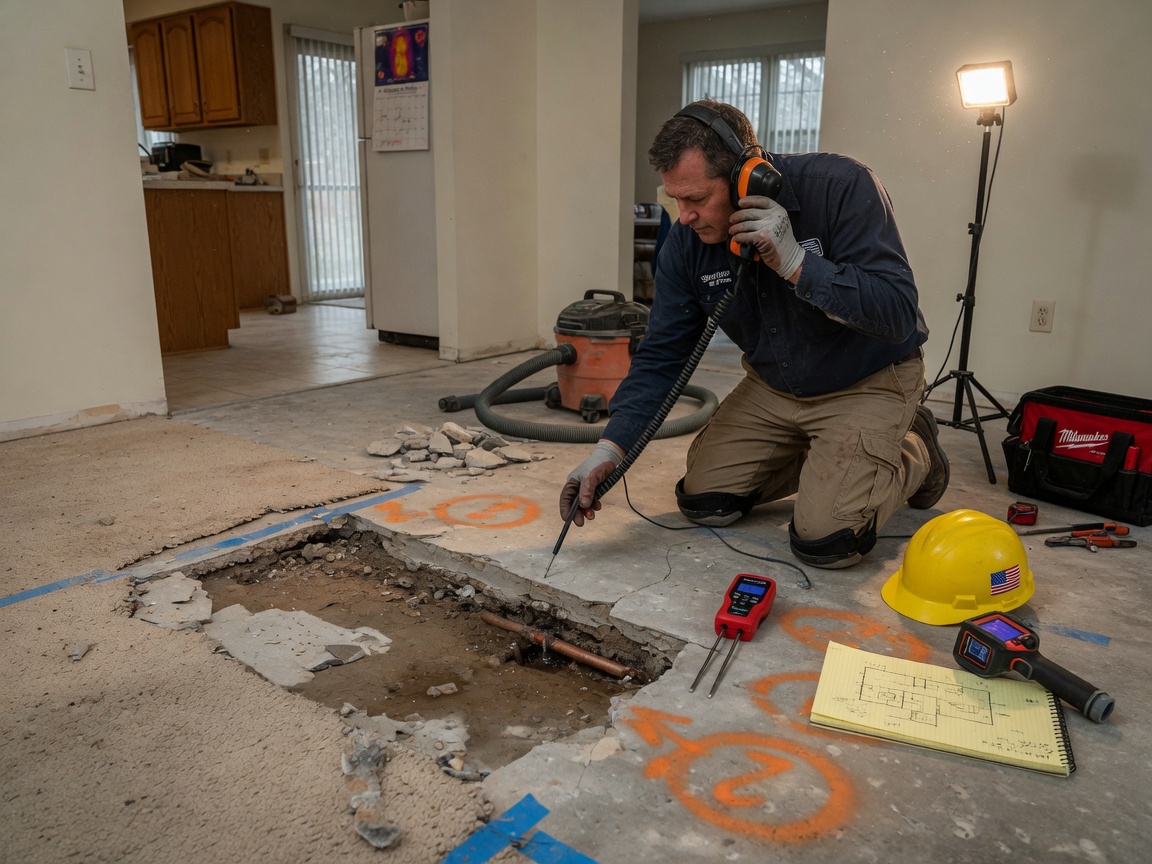
Sterling sits on clay-rich Loudoun County soils that expand and contract with the four distinct seasons. Warm summers keep pipes under steady pressure while chilly winters cause ground movement that stresses older slabs common in Sterling Park and Ashbrook. These conditions often produce small leaks that go unnoticed until moisture reaches finished floors or foundations near Claude Moore Park neighborhoods. Detection must account for both the soil type and the age of the concrete to avoid false readings.
Many homes built before the 2000s in Potomac Falls and near Dulles Town Center used copper or early PEX lines set directly in slabs. When a leak develops, water migrates along rebar or utility trenches, making pinpoint location difficult without the right equipment. Experienced techs start with pressure isolation and acoustic listening before moving to thermal imaging, because each step reduces the chance of cutting into sound concrete. Ignoring the seasonal soil cycle often leads to repeated callbacks after the first freeze-thaw cycle.
Local code in Loudoun County requires minimal disturbance when possible, so non-invasive detection is preferred before any slab removal. Techs also check for multiple leak points that can appear after a single repair in older tracts, especially when supply lines run near driveways or patios exposed to heavy summer irrigation. Proper documentation of findings protects both the homeowner and the next contractor who may work on the same property.
Technician insight
In Sterling the thing that catches most people out with Slab Leak Detection is the heavy clay soil in Loudoun County that moves during chilly winters, shifting slabs enough to create false acoustic echoes around older homes in Sterling Park.
Hidden Leak Near Driveway in Cascades
Homeowner noticed a warm spot on the garage slab after a warm summer followed by early freeze. Pressure testing isolated the line, then acoustic listening and thermal imaging located the leak under the driveway approach. We marked the spot, advised minimal removal, and the slab was repaired without disturbing the rest of the floor.
Slab Leak Detection Services We Offer
✓Electronic Leak Detection
Uses frequency signals sent through the line to locate leaks without breaking concrete in Cascades and Sterling Park homes.
✓Acoustic Listening Surveys
Amplifies water movement sounds under slabs to isolate leaks while accounting for traffic noise near Dulles Town Center.
✓Thermal Imaging Scans
Detects temperature differences caused by escaping water in slabs common to Potomac Falls and Ashbrook properties.
✓Pressure Testing and Isolation
Segments the plumbing system to confirm leak presence and narrow the search area before imaging begins.
✓Moisture Mapping
Creates a grid of moisture readings across the slab to show migration patterns after seasonal ground shifts.
Slab Leak Detection Cost in Sterling, VA
| Service | Typical Range | What Affects It |
|---|---|---|
| Standard Detection Visit | $275–$425 | Single-story homes in Cascades or Ashbrook with accessible shutoffs |
| Multi-Zone Pressure Isolation | $150–$250 | Added when separate hot and cold loops require individual testing |
| Thermal Imaging Add-On | $125–$200 | Used on older slabs near Potomac Falls with finished flooring |
| After-Hours or Saturday Call | $75–$125 | Available within posted hours at the Executive Drive location |
Ranges are typical for Sterling, VA and confirmed with an exact written quote before any work starts.
How it works
- 1
Initial Phone Assessment
Gather details on home age, recent water bill changes and visible signs in neighborhoods like Sterling Park or Cascades.
- 2
On-Site Pressure Check
Isolate zones and measure pressure loss to determine whether a leak exists before any imaging equipment is used.
- 3
Advanced Detection
Apply acoustic, electronic or thermal tools suited to local clay soils and slab thickness found in Loudoun County.
- 4
Findings Report
Provide marked locations, photos and repair options without unnecessary concrete removal.
Pricing
Most detection visits fall in a set range; final cost depends on home access, slab depth and whether multiple zones must be isolated.